“When “I” and “you” vanish,
how can I tell whether I am
in a mosque, a synagogue,
a church, or an observatory? ”
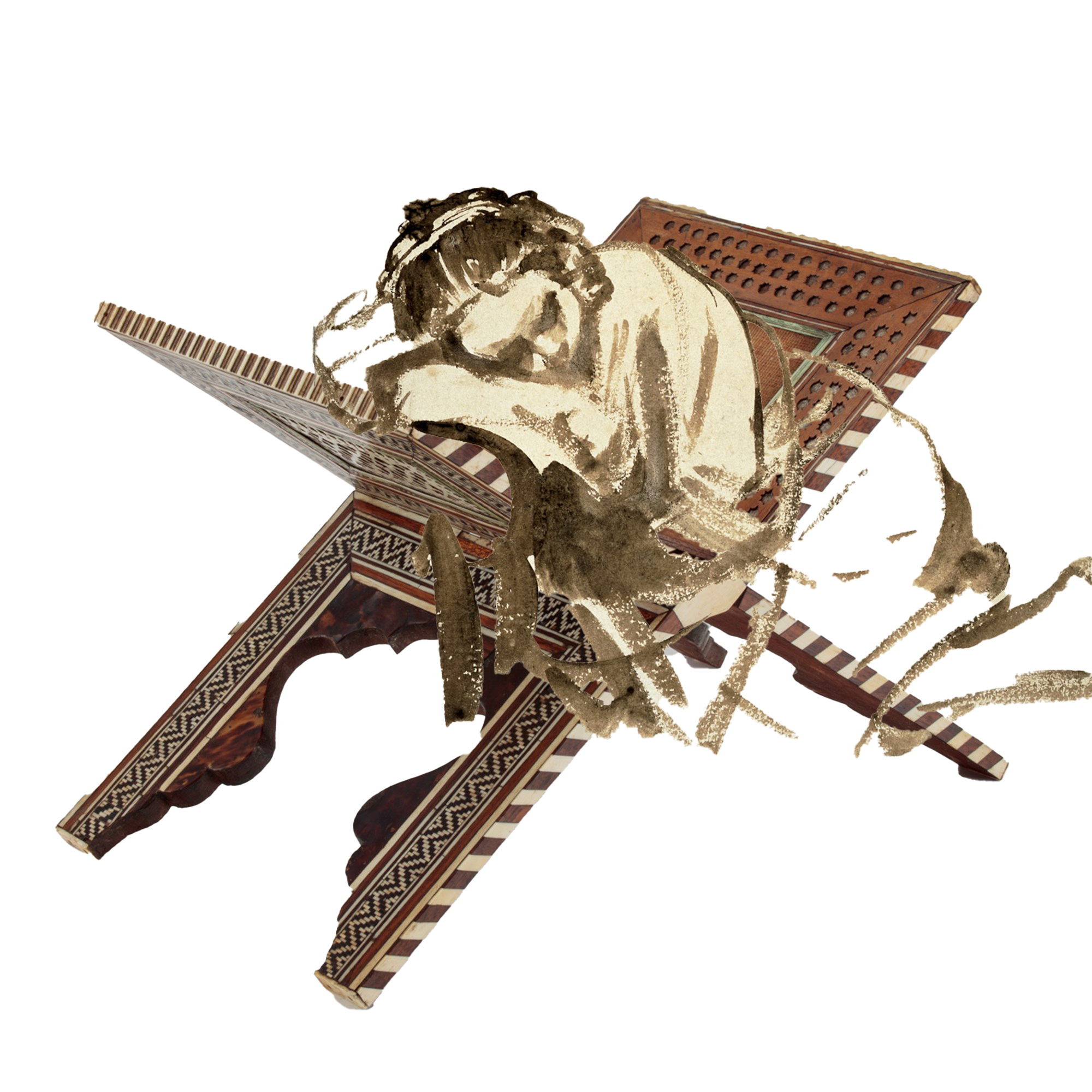
“You will find the Quran in you. You are the Quran. You are your own book.”
“Whereas we used to dream of living one day with what we write, we now dream of not dying one day because of what we write. ”
We are prisoners dancing in the guarded courtyard and mistaking it for freedom
I shed this pseudonym, this password concealing my writing like a veil imposed in the name of protection .. preventing the skin of these words from touching the world— for fear of offending the faceless, anonymous occupier of god and what I’m told are his properties on earth.
But the mosque is ours. The minaret, the mihrab, the holy text — ours. You have no permission to decide how an artist engages with her inheritance: what has wounded her, what has haunted her, and what can only be redeemed in communal possession.
Why on earth do we not question why Christian artists are able to engage with the symbols of religion, openly, and without fear, while Muslim artists have to hold their breaths and hide in the obscure poetry of fabric and in the allegory of photographs that suggest rather than rupture. We need a rupture. Our wounds demand nothing less than that. We need to march back to the mosque that poisoned every feminine breath, that carved a separate entrance and ordered our bodies and voices to the other side of the wall and more than that — demanded we bend our bodies to a man, to the voice of a man, the interpretations of a man, the warnings of a man.
No — enough.
We are prisoners and don’t know it. I’ve always believe that to be the worst part of the Arab woman’s confinement: her not knowing that she is confined.. a forgetting so profound we’ve forgotten what there was to recall.
We are prisoners content with the illusions of our freedom. We despise the woman that comes along and lifts the fabric of our lies — enough for us to see the locked legs beneath the skirt of our hours. We’d rather this lying freedom than the cost of the real one.
So long as we define freedom within Islam as those who follow and those who do not, this is what we live with. This is what we have. There is no space among the followers for variety, but there is enough space for performance: for what is shown publicly and what is lived privately. We have no room for questions, for newness, for risk, but we have all the space to hold two containers of life in the place of one. We survive on the Arab well of hypocrisy — a well large enough to water the entire tribe and all its generations —
until we empty it. Seal it.
Where is the sacred, subliminal space in between where I both follow and I do not, where I bow and I scream, where I listen with humility and I challenge your words?
Where is the space for the one who arrives at the mosque, prepared to pray, but insists on entering through the main entrance, who demands to stand before god, shoulder to shoulder beside the men, an equal?
Where is the space for the one who opens the Quran under the moonlight, uncovered, who sings the words into the open poetry they were always meant to be, who loses herself in the folklore of what is so foolishly read literally, who sleeps with the book under her pillow, unclean and holier than the entire congregation of white shrouds reciting as pilgrimage into an imagined reward?
Offense implies possession
Islam has no nepantla, no selah, no caesura — no sacred, poetic, ephemeral pause, no in-between space for truth to enter, for doubts, for questions, for revolution. There are rules, and there are those who reject these rules. But where is the in-between space to touch? To adopt one of the many decaying temples of doctrine and say — give it me, let me breathe life into it. Allow me to take this Islam into my studio — so that it can live! Allow it to breathe. Air it. Open it. Or are you scared?
Tell me, what about an artist’s touch demands from you such violence? What are you protecting?
Show me what, in you, was violated in their autonomous creations? I want to know.
When I touch the mosque, when I bring it into this body, what part of you am I touching that can’t bear the touch? When an artist paints a prophet, what wound convinces you that they have offended you, that in granting themselves the liberty of this painting they have have trespassed into a space that is solely yours? What pain makes you want this religion to be your own and only your own? What is it about their paint brush that reminds you of the soul robberies you’ve sustained? How similar does the artist’s entry into a shared religion feel to the moments in your life when you were forced to share something against your will? Did you share a mother with a stranger as I did? Did your bed multiply into three and one home became ten?
You think I speak from a place above you? That I mock you? But haven’t I behaved the same way with my lovers? Haven’t I treated everyone’s mother, father, friends, as threats taking this lover away from me? Like your god, haven’t I wanted this one sole source of love in my life to belong to be mine alone?
Does it occur to you that I know that desire, that I’ve lived the hunger that compels you to possess and leaks conquer into love? Would you believe me if I told you that I have lived what I condemn in you?
How else would I see it so clearly?
But there comes a time when you look down at your possessive hands and you read among the lines of your palms the deep, deep wounds that delivered you into this grown body — ravenous, unloved, untouched. And you stumble on a lover or god or something, and suddenly, the world expects you share it?
No, you won’t.
Until we do, dear stranger. Until we understand that a love we possess is a love that will be lost. There is no other way. A god that you share is a god that stays yours. A lover that is free is a love that is real. But reach for god and love with the hands of your ten-year old child, starving, ignored, unseen — and what you touch isn’t god but the idea of him, and it is this idea that you feel absolutely convinced you need to guard with all your life — because your body understands, even if you do not. What summons a fight was never real.
Just as I loved the image of every man in my life, and not the man himself. I fought with all my voice what couldn’t ever become mine, no matter the intensity of the battle. I emptied this womb into mirage loves. Again, I would my last breath to run to the water that wasn’t real.
Because what is real won’t ask that you write its life into war. Its life does not depend on your guardianship. The single stem of god’s forest of being wilts in the chock hold of a clenched hand. It wants the soft, open palms of a gatherer, walking about other seekers. Your single-handed possession of a forest that is not yours will rot the pieces you manage to steal. You’ll have your mosque, but the air will be stale, rotting, holding its breath beneath your lie. You’ll have your book, untouched, but unread, unlived.
And like a growing woman suffocated in the name of protection, your god will turn against you too, if you treat it this way.
How much pain could I have spared myself if I trusted there was enough? How much pain could you spare me if you trust there is enough god for all of us. There is enough Islam for all of us to touch. Enough temples for each to have their own.
What I enter, what I build, what I move, is not your temple but my own. I leave yours untouched. I leave you whatever closed or open temple you seek. I’ve no right to reshape and re-order the architect of what suits you. But I do have the right to return to the temple I inherited, and yes, destroy it, bring it down, scatter the rubble, and re-sketch the architecture. I touch Islam with the permission of having received my inheritance. In touching mine, I am not touching yours. I leave you your hunger, your need for certainty and answers. But leave me my desire to feed myself, to re-order my temple into a space where nothing is certain and nothing is answered.